All posts by ProPortfolio

How ruthless were The Beatles?

Published June 8, 2021

article-image

How ruthless were The Beatles – if at all?

Were they really just four lovable mop tops who loved shouting “Yeah, yeah, yeah!” to every “expert” who wanted to help them?

Until they got lucky?

Or merely uncompromising? No matter what the consequences might be?

The Beatles were perceived in various ways in the early days, both behind the scenes and in public: “charming”, “witty”, “ruthless”, “dangerous”.

But who were they really?

How ruthless did they have to be to carve out that world-shaking career?

And what were the repercussions for others?

Let’s take a look.

1. The love you make. The price you pay

Stars weren’t born back in the day, they were formed. And Larry Parnes was the UK’s top star-maker. No compromises, no questions.

He was the woodcarver. The popstar was Pinocchio. 

Your name would be chosen. Your hairstyle. Your image. Your songs. Potential stars were preened, packaged, and sold.

But not pampered. They did what they were told – sometimes without royalties. How ruthless was he? Extremely.

His biggest star was Liverpool’s Billy Fury, whose album “The Sound of Fury” is today regarded as one of the most important Rock ‘n Roll records produced in the UK.

Fury wrote the songs. However, rather than encourage him, Parnes convinced him to record covers, to guarantee hits in the accepted tradition.

Fury felt he had no choice – and we all paid the price.

Then Parnes met The Beatles.

Drawing of the early Beatles running in the streets of Liverpool.
The charge to Stardom. Getting in the way of The Beatles was a mistake.

2. Nowhere men to star-maker – “Get stuffed!”

When Parnes announced that he was coming to Liverpool, to audition groups to play backup for Billy Fury in an upcoming tour, the reaction was huge.

Especially when he added that Billy Fury would be attending.

For working-class kids in the North of England, this was the chance of a lifetime.

Allan Williams, The Beatles’ first manager, told the boys about it – and they jumped.

Turning up scruffy and unprepared, with a temp drummer who was late, they still managed to pass muster – according to Williams.

He claimed that Parnes and Billy Fury liked “The Silver Beetles” and wanted to sign them.

On one condition.

John’s best friend, Stu Sutcliffe, was bassist in the group. He kept his back to the audience to hide the fact he couldn’t play. Not good in a superstar’s support act.

He had to go.

One act of ruthlessness, one ticket to the top.

John Lennon’s “curt response” – apparently backed up without a note of dissension from McCartney or Harrison – ended their big chance.

Stu stayed. No compromises, no questions.

The Beatles walked out on Larry Parnes and Billy Fury.

Parnes later denied Williams’ account, perhaps conveniently blaming the temp drummer.

Either way, Williams did later manage to get The Beatles onto one of Parnes’ low-level touring tickets: Johnny Gentle’s Tour of Scotland.

So did The Beatles really tell Britain’s biggest star-maker, in front of the great Billy Fury, where to get off?

We do know that Johnny Gentle later encouraged Parnes to sign The Beatles; and that Parnes refused. Possibly because he knew he wouldn’t be able to control them.

In early 1962, Parnes also apparently turned down a chance to co-promote The Beatles’ concerts.

A decision that, if true, cost him millions.

When on the verge of stardom, The Beatles had no qualms about firing their drummer, Pete Best, despite his huge following of female fans in Liverpool, and the upset it would cause.

But that was their idea.

Within a couple of years, Beatlemania had dropped like an atom bomb on Larry Parnes’ stable of stars, and assigned the star-maker and his way of doing business to history.

The King was down. The game was on.

Waxworks of the four Beatles holding their instruments.
All you need is tough love. On the make, but not fake.

3. Prodigies to producer – “That song is crap!”

Still, they did get the attention of a Liverpool record store manager named Brian Epstein.

He also wanted them to compromise, so they did.

By the time Epstein told The Beatles they should replace their leather outfits with tailored suits, they had allowed Stu Sutcliffe’s girlfriend, Astrid Kirchherr, to turn their greasy rocker quiffs into floppy fringes.

This was more about curiosity than compromise. And Paul McCartney soon realized how great the suits would look with the new hairstyles.

For Lennon, it came down to Beatle democracy; but he probably knew McCartney was right.

With that agreed, they were ready to be rejected again. 

Dick Rowe of Decca Records was all about the data. After their audition, he uttered the now immortal words:

“Guitar groups are on the way out, Mr. Epstein.”

No compromises, no questions.

A ruthless business decision that went down in history as one of the worst days anyone ever had at the office.

Rowe, of course, later denied Epstein’s version.

Not that The Beatles minded. By this stage, they felt sorry for anybody silly enough to reject them.

So, with a later introduction and much encouragement from a now-famous George Harrison, Dick Rowe said “Yes!” to The Rolling Stones.

Phew!

Next in line was George Martin of Parlophone, EMI. Happily, Martin believed in following his instincts rather than just data and industry trends.

So he watched and listened. Then he signed them.

For their part, The Beatles were in awe. They didn’t know that EMI considered Parlophone a dumping ground for novelty trash.

To George Martin, The Beatles were popstars, and popstars needed professional songwriters.

He went looking for The Beatles’ first #1.

And he found it. Or thought he did: “How Do You Do It?” by Mitch Murray.

“This is it!” he told music publisher, Dick James. “This will make The Beatles a household name!”

The Beatles dutifully recorded it – and Martin was delighted.

Then they went quiet.

Lennon spoke up first. “I have to tell you, George,” he said. “We think this song is crap.”

Not only was Lennon’s statement outrageous, it was an assault on Martin’s ability and authority.

An act of ruthlessness? Or just another act of career suicide?

But The Beatles weren’t challenging Martin’s ability or authority. Lennon knew the song was good really.

They all knew it would be a hit.

Just not their hit.

They wrote those.

“Show me something as good as that and we’ll record it!” he boomed at Lennon.

Lennon and McCartney looked at each other and shrugged.

Fair enough.

Ultimately, Martin allowed The Beatles to release their own song “Love Me Do” – possibly because he knew Brian Epstein intended to purchase 10,000 copies himself, to ensure a chart placing and kickstart their careers.

Which he did, in politely ruthless fashion.

The follow-up “Please Please Me” was a John song, written in the style of Roy Orbison. They sang it Orbison style, but Martin heard it Beatles’ style.

By the time they were done recording, Martin made his now-famous announcement:

“Gentlemen, you have just made your first number one record.”

He was right. (Sort of.)

A collection of The Beatles' album covers.
Once the hits got started, they didn’t stop. And they changed the world.

4. Ruthlessness and repercussions – British invasion

In the States, many American acts went the same way as Parnes and his stars.

The Beatles changed everything.

And everything they did had repercussions.

After they rejected Martin’s choice of song, it was given to another Liverpool group, “Gerry and the Pacemakers”. 

Produced by Martin, this version of “How Do You Do It?” shot to the #1 position in the UK, technically beating The Beatles to the #1 spot. (“Please Please Me” hit #2 on the Record Retailer chart and #1 on the New Musical Express and Melody Maker charts.)

Becoming part of “The British Invasion” the song broke the Top 10 in North America in the summer of 1964.

It was replaced at the top in the UK by The Beatles’ third single “From Me to You”, which hit the #1 position and stayed there for seven weeks. From here, The Beatles never looked back.

Arguably, the four mop tops kickstarted (at least) four industries:

The Beatles, The Rolling Stones, The Mersey Sound, The British Invasion.

The Beatles destroyed and started a lot of careers.

When they decided to stop touring, they were informed that they were destroying their own.

All the data spoke to it. Industry reality. No way round it.

But The Beatles had other ideas.

A lot of them.

Picture cover and vinyl album of The Beatles' "A Hard Day's Night" soundrack.
The Beatles never stopped working, innovating, believing, or succeeding.

One was to create pop music’s most influential masterpiece, while apparently failing to understand that their careers were over.

So what about your career?

5. No compromises, No questions: Your career

If you had a once-in-a-lifetime opportunity, could you turn it down on principle?

If an authority figure/expert told you to do something “for your own good”, could you be ruthless enough to respond:

“No – that doesn’t work for me.”

The Beatles did this all the time, regardless of how unpopular or outrageous.

But only in specific circumstances. If a compromise suited them, they’d make it.

In fact, “uncompromising” may be the better word to use in many of these instances than the word “ruthless”.

Larry Parnes and Dick Rowe also had their “No compromises, no questions” attitudes.

In the former’s case, these were ego-based and ended his reign; in the latter’s, a crushing error led to professional redemption.

The Beatles had an amazing grasp of who they were and what they wanted.

If something felt wrong on principle, it couldn’t and wouldn’t happen.

So let’s end with The Beatles’ top five “no compromises, no questions” hits.

Top 5 things nobody could get The Beatles to do:

  1. Dump their own people – unless it was their idea.
  2. Release singles they hadn’t written – unless it was their idea.
  3. Fill their albums with singles to milk cash from kids.
  4. Go to the US until they had a hit single there.
  5. Play to segregated audiences in the US.

Ruthless little mop tops.

Sources: The Love You Make: An Insider’s Story of the Beatles by Peter Brown and Steven Gaines – published by McCraw-Hill, 1983; Here, There and Everywhere by Geoff Emerick and Howard Massey – published by Gotham Books, 2006; Shout by Philip Norman – published by MJF books, 1981; John Lennon – The Life by Philip Norman – published by Ecco Press, 2008. Images: Shutterstock.

Elton John: How the man who got everything the wrong way round turned America upside down

Published June 22, 2021

article-image

Elton John turned America on its head after getting everything the wrong way round.

So how did he do it?

A tad too late for The British Invasion, America wanted American acts.

Elton wanted to break big in Britain, probably because he knew where to shop.

But his rockstar-handsome British writing partner wanted to be a cowboy.

Is that it?

Let’s take a look.

1. Reginald Dwight sits upright, uptight, out-of-sight

The only thing young Reginald Dwight wanted to be when he grew up was Little Richard.

Or Jerry Lee Lewis. (Plan-B, in case something went wrong with Plan-A.)

But the young piano player with a cheeky grin was nobody’s idea of a future rock ‘n roll star.

Despite being a naturally gifted piano player who’d started formal lessons aged seven.

And who, by age 11, was granted a scholarship to the Royal Academy of Music.

Obliged by his strict upbringing to be a good student, Reg swapped Little Richard for Frédéric Chopin

…Jerry Lee Lewis for Johann Sebastian Bach.

Allowing Beethoven to rule over rather than roll over.

For five long years.

While his itching feet stayed firmly under the piano, never on it.

In sensible shoes, to match a restrained attitude.

And nursing a frustration as explosive as the rock ‘n roll he loved.

To the point that, as the countdown to his final exams began, his piano stood silent.

Rocket Man had taken off.

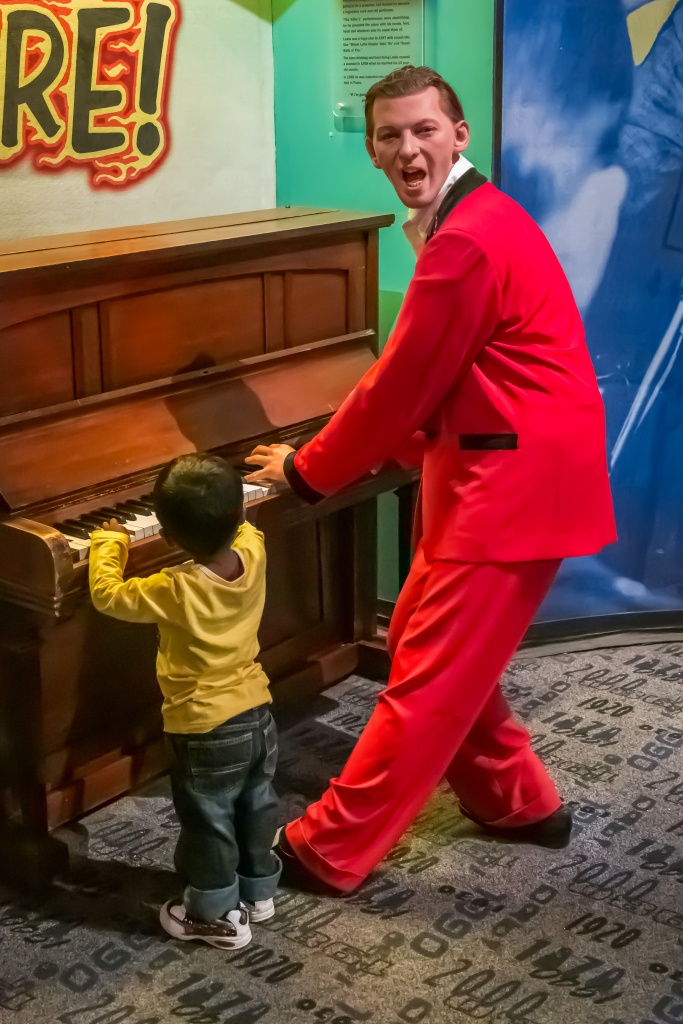
Wax image of a young Jerry Lee Lewis standing as he plays a piano beside a young boy.
Great balls of fire and the big dreams of little kids.

2. Long John, Bluesology, and letting the heartaches end

Reginald Dwight, organ player with Bluesology, stood motionless on stage, wearing a caftan, some bells, and a chain around his neck, as eccentric blues legend, Long John Baldry, belted out his awful #1 hit song ‘Let the Heartaches Begin’.

Backed not by Bluesology, but by a massive tape machine.

What?

Baldry had a great talent for spotting talent and had become a friend and mentor to Reg.

Friends with Paul McCartney, Baldry had shared the stage with both The Beatles and The Rolling Stones; a living encyclopedia of the blues, he became a legend’s legend.

“He was the greatest 12-string guitarist the UK has ever produced.” — Elton

But his middle-of-the-road hit single had blown a hole through his backing group.

Their regular audience of blues-loving young mods had been replaced by the supper club set, chicken and fries falling from the mouths of well-to-do women as they screamed, making a beeline for the stage in a stiffly middle-aged, but unstoppable tinkle of passion.

Eww.

Nobody knows if Reg ever formed the words, “Somebody save my life tonight – please!” in his mind, but we do know that Elton’s acclaimed autobiography “Me”, tells the story of a gifted rhythm and blues band put in an extremely awkward position.

Besides, there was no way to reproduce the orchestrated sound. Or female chorus.

So they stood there instead, like lemmings before the leap.

With aching heart, Elton leapt.

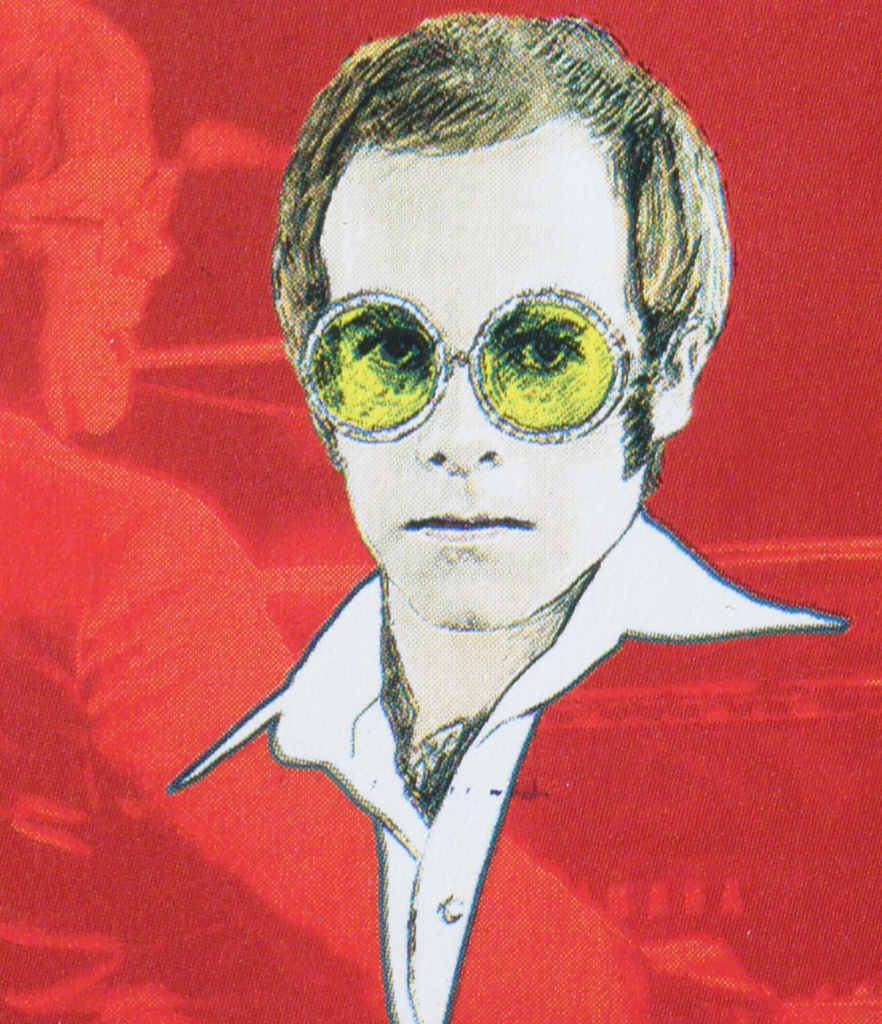
A drawing of a young Elton overlaying a photo of Elton playing the piano.
Reg Dwight: The background musician who needed to be upfront.

3. Enter the brown dirt cowboy (wheelbarrow operator, UK)

By the age of 17, Bernie Taupin had developed an optimistically casual attitude to life.

Apart from carting dead chickens around his father’s farm in north-Lincolnshire, he had ended a planned career as a journalist in favor of roaming country roads, playing pool, meeting girls, and drinking heartily.

It was only a matter of time before he became friends with Rod Stewart.

He also wrote poetry.

A lot.

In 1967, Reg Dwight and Bernie Taupin were two of many hopefuls who answered an advertisement placed in New Musical Express.

Liberty Records wanted new talent.

Unlikely rockstar Reginald showed up, played some favorites, and essentially flopped.

When he shyly said that he could write songs, A&R man Ray Williams’ ears pricked up.

“But not the words,” Reg added.

Williams sat back and sighed.

Lifting an envelope from his desk, he handed it to Reg, probably as a gesture.

Bye, Reg Dwight.

On the train home, Reg opened the envelope and read the beautiful mind of Bernie Taupin.

They clicked.

Whether fate decreed stardom or starvation – they were already in it together.

A photograph of lyricist and poet Bernie Taupin.
The Greatest Discovery: Songwriting partner and brother.

4. Elton John and Bernie Taupin – “We’re starving!”

Reg found that he could write melodies easily for the majority of Taupin’s lyrics; and he started doing so before they met.

When they did meet, they hit it off immediately.

Soon, Bernie was living with Reg and his mother and stepfather in a tiny apartment. They slept in bunkbeds and bonded over their love of Bob Dylan, Jimi Hendrix, and others.

Taupin was a fish out of water in London and a bit overwhelmed. Elton, sensing this, developed a big brother protectiveness for the teenager others saw as a “country bumpkin”.

Even though Elton was only 20 himself.

Although awed by Reg’s talent, and perhaps missing the security of a steady wheelbarrow, his new friend’s kindness boosted Bernie’s confidence and creativity.

“He became the brother I never had,” Elton later said.

Neither was making money, so they scraped by, scrounged up, and kept honing their talents.

In 1968, they managed to join DJM Records as staff songwriters, turning out occasional songs for stars such as Lulu, Roger Cook, and Edward Woodward.

Later, somebody suggested they should perform their own songs.

They agreed; but only as long as they could do everything the wrong way round.

  1. Rockstar handsome Bernie and shy, cherubic Reg, chose Reg as the frontman.
  2. Reg took the name ‘Elton’ from Bluesology bandmate Elton Dean; and the name ‘John’ from Long John Baldry – then fixed them together the wrong way round.
  3. ‘Elton John’ hoped to have hits in Britain, without a thought for the US.

What could go right?

Album cover of Elton John's hit album: 'Captain Fantastic and the Brown Dirt Cowboy'.
Years later, Elton and Bernie would write a classic album about their early days.

5. Drifting slowly through an empty sky

Elton’s first single ‘I’ve Been Loving You’ resulted in nobody caring how he felt.

His second, the now classic ‘Lady Samantha’ didn’t fare much better, but did become a ‘turntable hit’, attracting the attention of industry people, such as producer Gus Dudgeon, and rock critics.

His third single: ‘It’s Me That You Need’ saw critics predicting another radio hit.

They were wrong.

His first album ‘Empty Sky’ didn’t fare much better; and wasn’t even released in the US.

But there was a learning curve happening.

Elton and Bernie saw ‘Skyline Pigeon’ as representing a new level for them as songwriters.

They listened. Looked at each other. And never looked back.

For the second album ‘Elton John’, admirer Gus Dudgeon was brought on board.

The stunning ‘Border Song’ was released in the UK, but also failed to chart. 

In an interesting turn, American rock group ‘Three Dog Night’ recorded both ‘Lady Samantha’ and ‘Your Song’ as album tracks.

They decided not to release ‘Your Song’ as a single, so that Elton could “have a go” with it.

An American ray of sunlight in their empty sky.

Picture cover and vinyl album of 1974's: "Elton John's Greatest Hits".
Elton. Bernie and Gus Dudgeon: The trio that turned the world on its head.

6. John Elton – Sorry, Elton John – has arrived!

Bernie was excited about a gig at the tiny but trendy Troubadour Club in LA, USA.

Elton wasn’t as impressed. 

It seemed a long trip just to (hopefully) get a nice write up, or impress some industry folk.

Concentrating on the UK seemed a lot more sensible. And he knew the shops.

Then Dick James said he’d negotiated Elton’s payment up from $150 to $275.

Meaning Elton could stop pressing his nose against shop windows and actually go inside.

SOLD!

Meanwhile, US record executive, Russ Regan, heard the ‘Elton John’ album.

“When I heard it for the first time, I absolutely flipped out. I looked up at the sky and said, ‘Thank you, God!’ I thought it was one of the best albums I’d ever heard.” — Russ Regan.

Phone calls were made.

Influential people needed to get their asses over to the Troubadour and see this John Elton guy.

Sorry – Elton John guy.

Elton was made the headliner, even though nobody knew who he was.

Music publisher, David Rosner, had 3000 UK copies of the ‘Elton John’ album shipped to the US for distribution to radio stations – months before a US release.

When Elton, Bernie, and their backing group finally climbed stiff-legged from the economy flight onto US soil, they were greeted by a bizarre sight.

A red London double-decker bus with a banner proclaiming: ‘Elton John has arrived!’

All beautiful, small-scale hype, based on upbeat energy and enthusiasm.

But it created an incredible vibe.

Then came the gig.

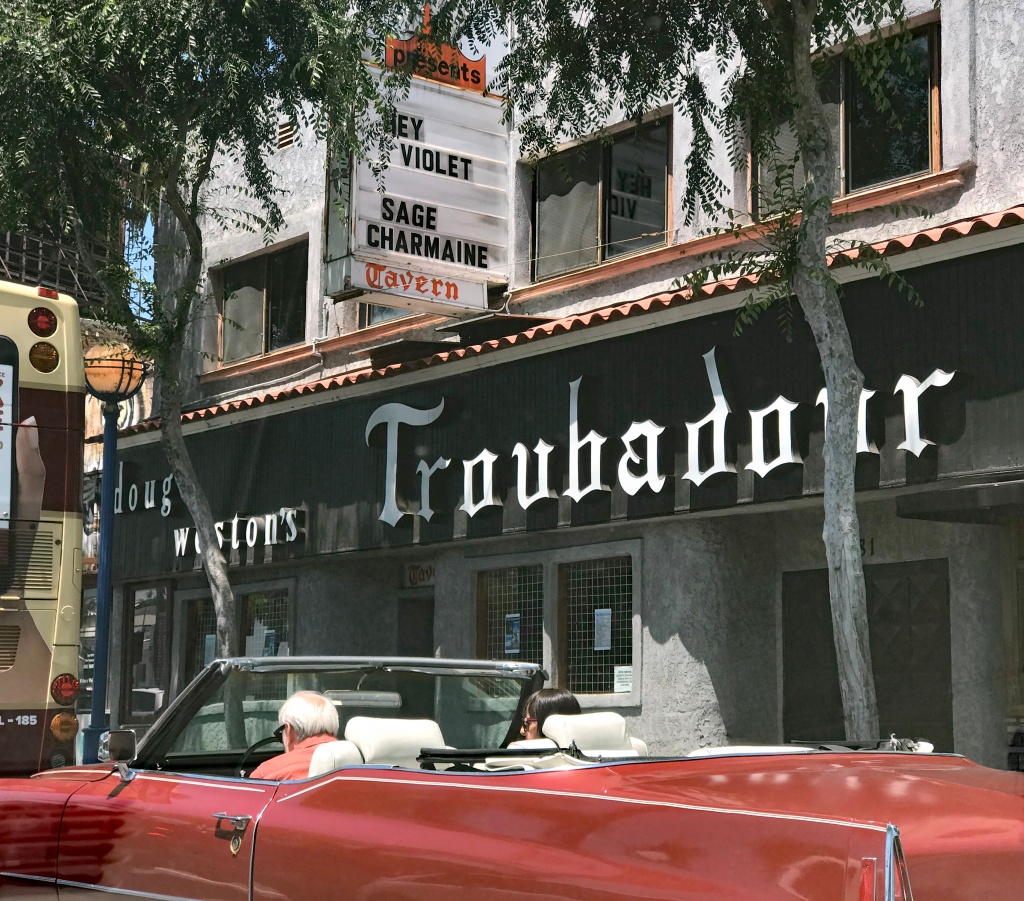
Photograph of the outside of L.A.'s famous Troubadour nightclub.
Welcoming a new era in rock ‘n roll: The Troubadour in L.A.

7. Don’t Go Back, Honky Cat! The Troubadour goes BOOM

On August 25, 1970, Elton John opened at the Troubadour nightclub.

With a capacity of around 300, curious audience members included Neil Diamond (who agreed to introduce Elton), highly influential Times critic Robert Hilburn, David Crosby, Stephen Stills and Graham Nash, Quincy Jones and Peggy Lipton, Linda Ronstadt, Brian Wilson and Mike Love, Van Dyke Parks, Don Henley and Randy Newman.

No pressure, then.

Probably expecting an earnest British singer-songwriter, the audience was staggered by an explosion of Rock ‘n Roll not seen since the days of Little Richard and Jerry Lee Lewis.

Elton was making sure little Reginald Dwight’s dreams came true.

Relentlessly pounding the piano, he threw himself into the air like an acrobat, kicked away his stool, and dropped to his knees.

Never missing a beat or a Bernie Taupin line of poetry.

“It was like a ball of fire hit the Troubadour. When he got to ‘Take Me to the Pilot’ the place levitated.” — Linda Ronstadt. 

When Elton came down again and played a slow song, they gasped.

Suddenly Little Richard and Jerry Lee Lewis were George and Ira Gershwin.

Not possible – but happening.

LIVE

When it was over, the audience were as physically and emotionally exhausted as the star.

Because that’s what he was now. All at once and unequivocally.

A STAR

Proclaiming that Elton John would soon become one of rock’s biggest and most important figures, the Times critic Hilburn began his review with one simple word:

“REJOICE”

Nobody would ever again think of the name ‘Elton John’ as being the wrong way round.

Apart from Groucho Marx, obviously.

Album cover of Elton John's classic 1973 double album: "Goodbye Yellow Brick Road".
Hello Yellow Brick Road. Even this classic image is the wrong way round.

8. Hello Yellow Brick Road

Elton played eight shows in six nights at the Troubadour.

He became a sort of instant underground legend until the US release of ‘Elton John’ a few months later.

It reached the US Billboard Hot 100 #4 position.

Your Song’ reached #8 – a surprise hit, having been released as the B-side of ‘Take Me to the Pilot’, and played relentlessly by DJs who fell in love with it.

It also hit the #7 position on the UK chart.

Elton John never pressed his nose against a shop window again.

Apart from once in 1978, when Saks closed early.

Following up on further early achievements, Elton went on to muster up:

7 consecutive #1 US albums
27 Top 10 US singles; 9 #1 US singles; 100 million singles worldwide
33 million copies of ‘Candle in the Wind 1997
2 percent of global record sales; 1 in every 50 records bearing his name
300 million record sales worldwide
250,000 pairs of sunglasses (although there may be more on top of his wardrobe)
Around $600 million raised to combat AIDS and for other causes (he supports 64 charities; 33 causes)
$500 million estimated net worth

Bernie Taupin owns three pairs of cowboy boots and a 10-gallon hat.

They still write songs together.

Not bad, Honky Cats.

Sources: Me: Elton John Official Autobiography by Elton John – published by Henry Holt and Co., 2019; Captain Fantastic: The Definitive Biography of Elton John in the ‘70’s by David John DeCouto – published by Triple Wood Press, 2016; Elton: The Biography by David Buckley – published by Andre Deutsch, 2007.

Bob Dylan’s controversial career: 1961-1965

Published May 20, 2021

article-image

Artist? Hustler? Schemer? Dreamer?

Bob Dylan’s controversial career as a singer/songwriter made him the icon of a generation, a reluctant recipient of the Nobel Prize in Literature, and an almost mythical being.

Known to confuse facts and fantasy about himself as readily as anybody who ever spoke or wrote about him, he is an enigma, with many detractors and millions of admirers. 

So what can we learn about – and from – Dylan’s career?

Let’s take a look.

1. Was Dylan’s early image a fraud?

Yes and no. Before his 20th birthday, Dylan was singing for free at Gerde’s Folk City “Hootenannies” in Manhattan.

Originally rejected for looking too young, he caused a stir from the outset.

A teenager with puppy fat singing folk and blues songs about hard-travelling, lost loves, and hoping only for a clean grave to sleep in, Dylan was working strictly against the odds from a career perspective.

So what happened?

It’s tough to choose between “self-belief” and “self-delusion”. When Dylan sang adult themes, usually in the style of Woody Guthrie, his pained vocalizing created an air of authenticity that wowed people. He appeared to be living the image.

Then came strategy.

Before people could absorb the contradiction between songs and singer, Dylan would break into a humorous number, becoming the star of the song — a Charlie Chaplin character — who everybody fell in love with.

Including folk critic for The New York Times, Robert Shelton.

Cartoon image of a young Bob Dylan playing acoustic guitar.
Young Bob Dylan – A self-created image he believed until everybody else did.

2. Is Dylan a plagiarist?

No — Dylan came from a folk tradition in which a traveling “guitar picker” would hear a song, remember the tune, then add words.

When “Big John” Hammond signed Dylan to Columbia, Hammond was legendary as a jazz producer and the discoverer of Billie Holiday. He signed Dylan on instinct.

Their first album contained two original Dylan songs and didn’t sell.

This was a controversial career move for Hammond himself. Dylan quickly became known as “Hammond’s Folly”.

That ended with the release of Dylan’s second album, “The Freewheelin’ Bob Dylan”.

The album was crammed with Dylan classics like “Blowin’ in the Wind” “Girl From the North Country” “Don’t Think Twice, It’s Alright” and “Masters of War”.

And it sold.

Dylan’s new manager, Albert Grossman, gave “Blowin’ in the Wind” to one of his other groups, “Peter, Paul and Mary” who had a huge hit with it.

Dylan the songwriter had arrived.

With his album “The Times They Are a Changin’” came trouble. Dylan’s song “With God On Our Side” used the same melody as Dominic Behan’s Irish rebel song, “The Patriot Game”.

Behan was outraged, until a music expert pointed out that Behan himself had taken the melody from another song, in line with folk tradition.

It’s hard to know how seriously Dylan took this.

Even today, fans love picking out uncredited quotes on Dylan albums, from classic literature and poetry to Clint Eastwood movies.

Fans say Dylan loves to drop literary and cultural “clues”, while detractors call it plagiarism, plain and simple. But there’s nothing plain or simple about Dylan.

Including his huge career risks.

Image of Bob Dylan circa 1965.
Bob loves singing up a storm. And he’s good at causing them, too.

3. Did Dylan “sell out” for money?

The accusation doesn’t add up. It’s well documented that Dylan’s first love was rock ‘n roll – it’s what he first played, before discovering Woody Guthrie and going a different route.

He also became disenchanted with the folk “protest” scene. Even his early albums brought criticism from folk contemporaries, claiming he kept moving into “personal” songs, rather than sticking to politics. 

Dylan reacted with an album that cried out for electric music and moved closer to Rock ‘n Roll, with a record-company title he despised: “Another Side of Bob Dylan”.

One of the songs “My Back Pages” lamented his recent political past, declaring:

Ah, but I was so much older then/I’m younger than that now.

Dylan was fascinated by how The Beatles were changing Rock ‘n Roll; and angry that Americans weren’t doing more to compete with “The British Invasion”.

It’s no coincidence that Dylan’s next, half-electric album, was titled: “Bringing It All Back Home”.

Also, Dylan’s first electric single was hardly a surefire hit.

Mixing skip-rope and/or oldie scat song rhythms with lyrics about drugs and the emerging counterculture was a far cry from pop culture in early 1965. (And would stay that way until the emergence of rap.)

Influenced by Guthrie/Seeger’s ‘Taking It Easy’ and Chuck Berry’s superb use of this traditional style: ‘Too Much Monkey Business’, Dylan stripped down any commercial distractions or considerations, making only the relentlessly driving form and biting social commentary the stars.

Jack Kerouac’s brooding beat vision was also an unhidden influence.

Dylan was taking a huge risk with his reputation and career.

Which included isolating his audience. The folk purists went berserk when Dylan plugged in an electric guitar, and took to following him to concerts just to boo and create problems.

The planned move to full electric also threatened the many cover versions of his acoustic songs, from which he made big money as songwriter – on top of his own record sales.

However, despite or because of its originality, “Subterranean Homesick Blues” hit the Top 40 in the US and the Top 10 in the UK.

Dylan’s gamble had paid off. Or had it?

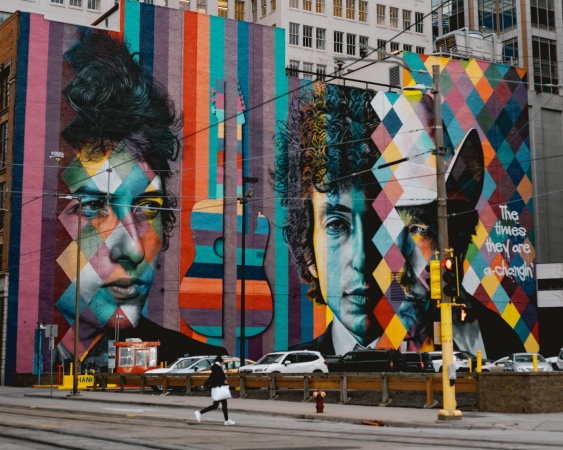
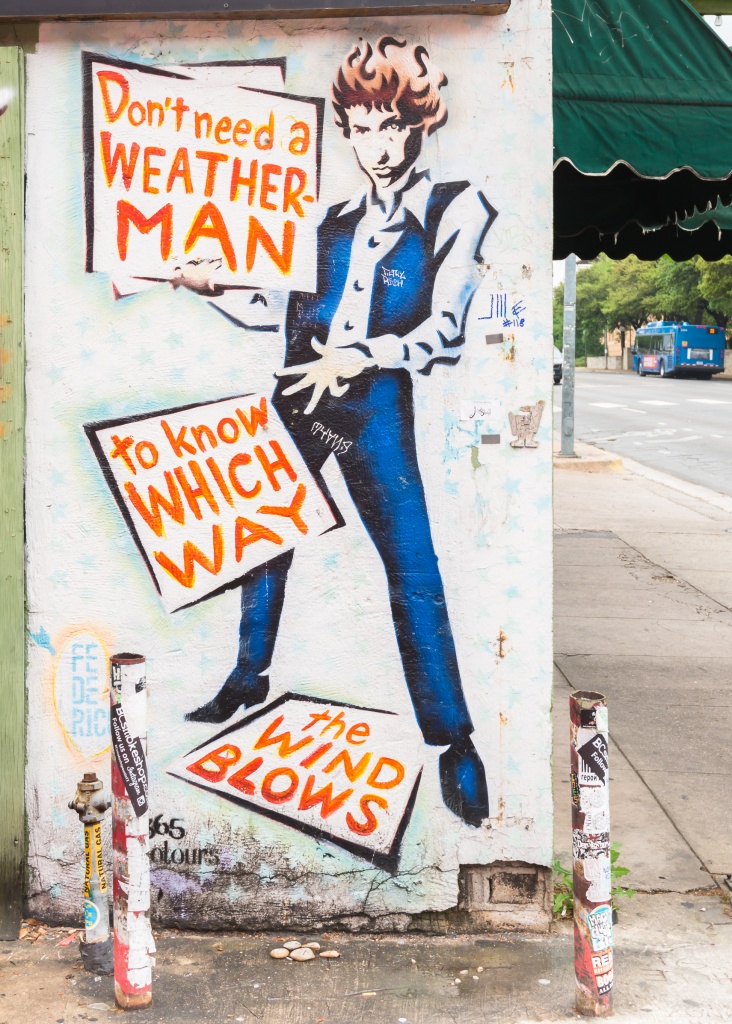
A street painting celebrating Bob Dylan's hit single and video: "Subterranean Homesick Blues" from 1965.
Dylan went from protesting on the street to being celebrated on it.

One of Dylan’s acoustic songs from Bringing It All Back Home, “Mr. Tambourine Man” was covered by The Byrds and hit #1 in the US and UK; other covers by the group cemented Dylan’s money-making success as a songwriter for others.

But his plan didn’t change.

A single from his fully electric followup album, “Highway 61 Revisited” was over six minutes long – unheard of at the time. The song, “Like a Rolling Stone” was also an explosion of searing anger and pain.

The song was so long and so angry that Dylan’s record company didn’t want it released.

Luckily, an acetate of the song fell into the hands of some influential DJs and rock journalists, who put pressure on the company until they relented.

Like a Rolling Stone” hit the #2 spot on the US Billboard Hot 100 and was a top 10 hit in many countries, changing popular music.

It also inspired The Beatles to ramp up their songwriting and experimentation.

Ultimately, it was voted #1 on Rolling Stone magazine’s list of “The 500 Greatest Songs of All Time.”

A stamp bearing the image of a young Bob Dylan.
Stamp of approval? Dylan is today celebrated everywhere.

4. What career lessons can we learn from Dylan?

When Dylan believed in something, he lived it unabashedly. What the “rules” were and what others thought meant nothing.

Dylan never stuck to a “winning formula”; instead he followed his vision, experimented, and stayed true to himself.

Between 1961 and 1965, Dylan built and risked destroying his reputation and career. In the years that followed, he repeated that many times.

So how do we make sense of this?

Let’s allow the great man to define career success himself:

“When you get out of bed in the morning, go to bed at night, and – in between – do whatever it is you want to do, that’s success.” — Dylan. 

Sources: No Direction Home: The Life and Music of Bob Dylan by Robert Shelton – published by William Morrow/Beach Tree Books, New York, 1986; Bob Dylan by Anthony Scaduto – published by Abacus, 1972; Chronicles Volume One by Bob Dylan – published by Simon & Schuster, New York, 2004.